
For roughly half a century, some of the sharpest minds amongst the scientific and mathematical communities were certain a planet circled the Sun within Mercury’s solar orbit. Well, they were wrong, and it took a revolutionary idea about gravity to understand that.
The Discovery of Neptune
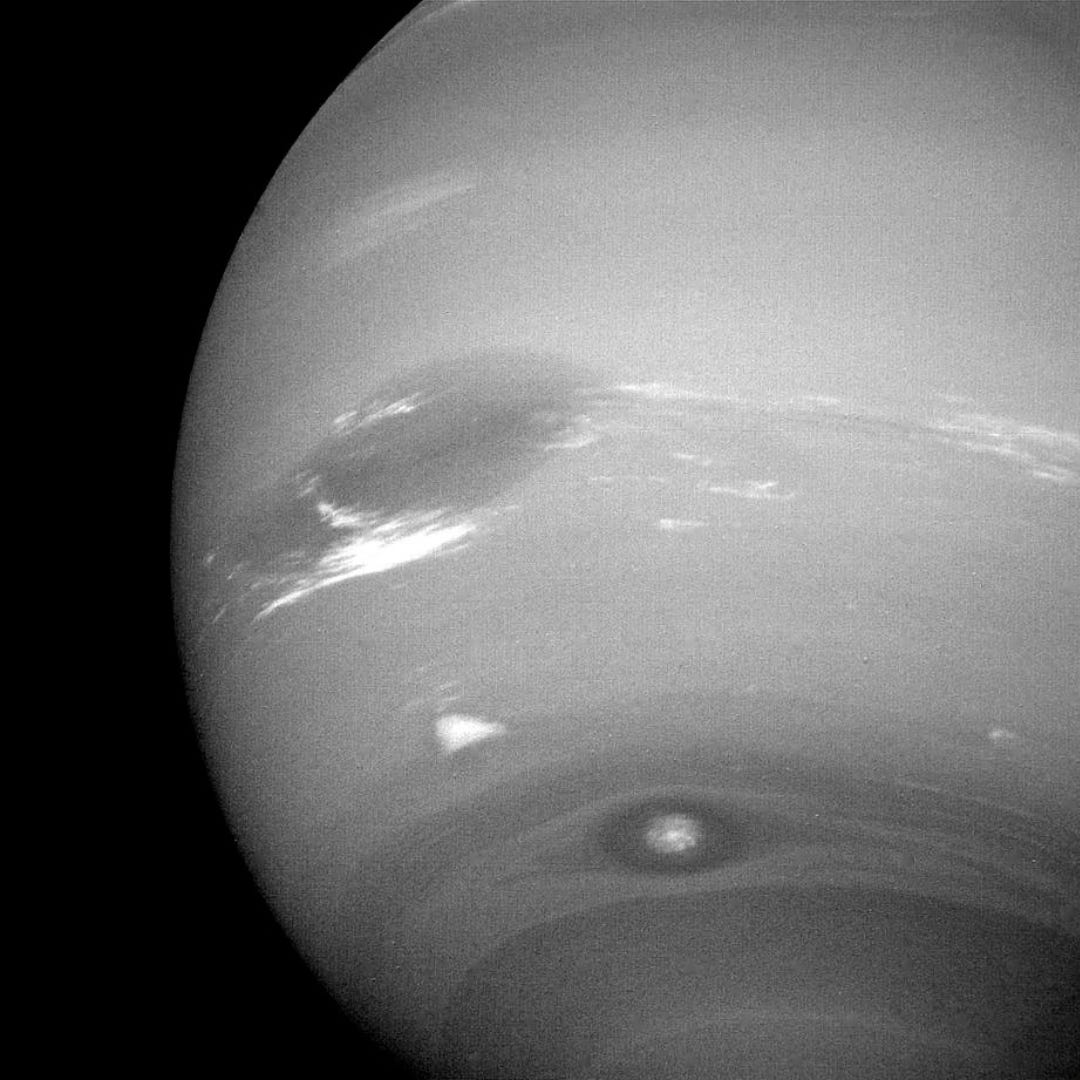
To understand why scientists thought a planet existed within Mercury’s orbit, we must first turn our attention to one of the greatest triumphs of nineteenth-century astronomy. In 1864, the French mathematician Urbain Le Verrier did something unheard of before. He discovered a planet without ever seeing it, using pure mathematics.
Uranus kept straying from the path Newtonian physics said it should follow. Le Verrier reasoned that something with enough mass must be pulling on it that had not yet been observed. On September 18th, 1864, he wrote to Johann Galle at the Berlin Observatory and instructed him to point the observatory’s 9-inch achromatic refractor to a specific section of the night sky. And 5 days later, Neptune was discovered.
Think about that. One of the greatest astronomical achievements of the 19th century came from the desk of a Parisian mathematician. That man at the desk, armed with nothing but Newtonian physics and arithmetic, had reached out across 2.7 billion miles of space and put his finger on a new world.
So, when Mercury’s orbital motion didn’t quite follow the path it should under 19th-century physics, the logical conclusion was that a body of mass lay between it and the Sun, masked by solar glare.
The Missing 43 Arcseconds
To understand why Mercury attracted the attention of scientists and mathematicians, we need to understand its orbit. Mercury’s orbit is elliptical, and the point where it is the closest to the Sun is called the perihelion. However, that point doesn’t just stay put. It slowly creeps around the Sun in what is called the precession of Mercury’s perihelion, as it gets tugged by the other planets in the solar system.
This precession can be calculated using Newtonian physics; however, a problem emerged between what Mercury’s orbit should be and what observations show.
The problem is that Mercury was actually precessing about 574 arcseconds per century, verified through multiple observations, when the math says it should be only 531 arcseconds. So, what is causing this discrepancy?
Now, 43 arcseconds doesn’t sound like much, and it isn’t. An arcsecond is measured as 1/3600th of a degree, about the width of a dime seen from a couple of miles away. Forty-three of them is only about a hundredth of a degree, and that movement is spread across an entire century. But regardless, it was there, orbit after orbit, and no amount of recalculating would make it go away.
Remember Neptune? This is where the stories connect. Le Verrier had already pulled off a mathematical wonder in discovering Neptune, so when he came across Mercury’s strange orbit, he reached for the same playbook. Something unseen had to be pulling on Mercury, and in his view it was a planet, or perhaps a swarm of smaller masses orbiting closer to the Sun.
Now, we can’t have a mysterious planet without a name, so they chose Vulcan, named for the Roman god of fire and the forge. It was a fitting choice for a world that would be roasting by the Sun.
The French Countryside Doctor
On March 26th, 1859, Edmond Lescarbault, a country doctor and amateur astronomer, living in Orgères-en-Beauce, about 43 miles southwest of Paris, reported watching a black dot cross the face of the Sun for 1 hour, 17 minutes and 9 seconds.
When Le Verrier heard about it, he traveled to Orgères to question the man in person. The result of that visit filled Le Verrier with satisfaction, and on January 2nd, 1860, he announced the discovery of Vulcan to the Paris Academy of Sciences, complete with an orbit:
Distance from the Sun: about 13 million miles, far inside Mercury’s orbit
Orbital period: 19 days and 17 hours
Tilt: 12 degrees, 10 minutes relative to the plane of the planet’s orbit
Greatest apparent separation from the Sun: 8 degrees.
Even with all these details, he met opposition. Emmanuel Liais, an astronomer in Rio de Janeiro with a telescope twice as powerful as Lescarbault’s, was watching the Sun at the same time and flatly denied that any planet had crossed it.
The Hunt for Vulcan
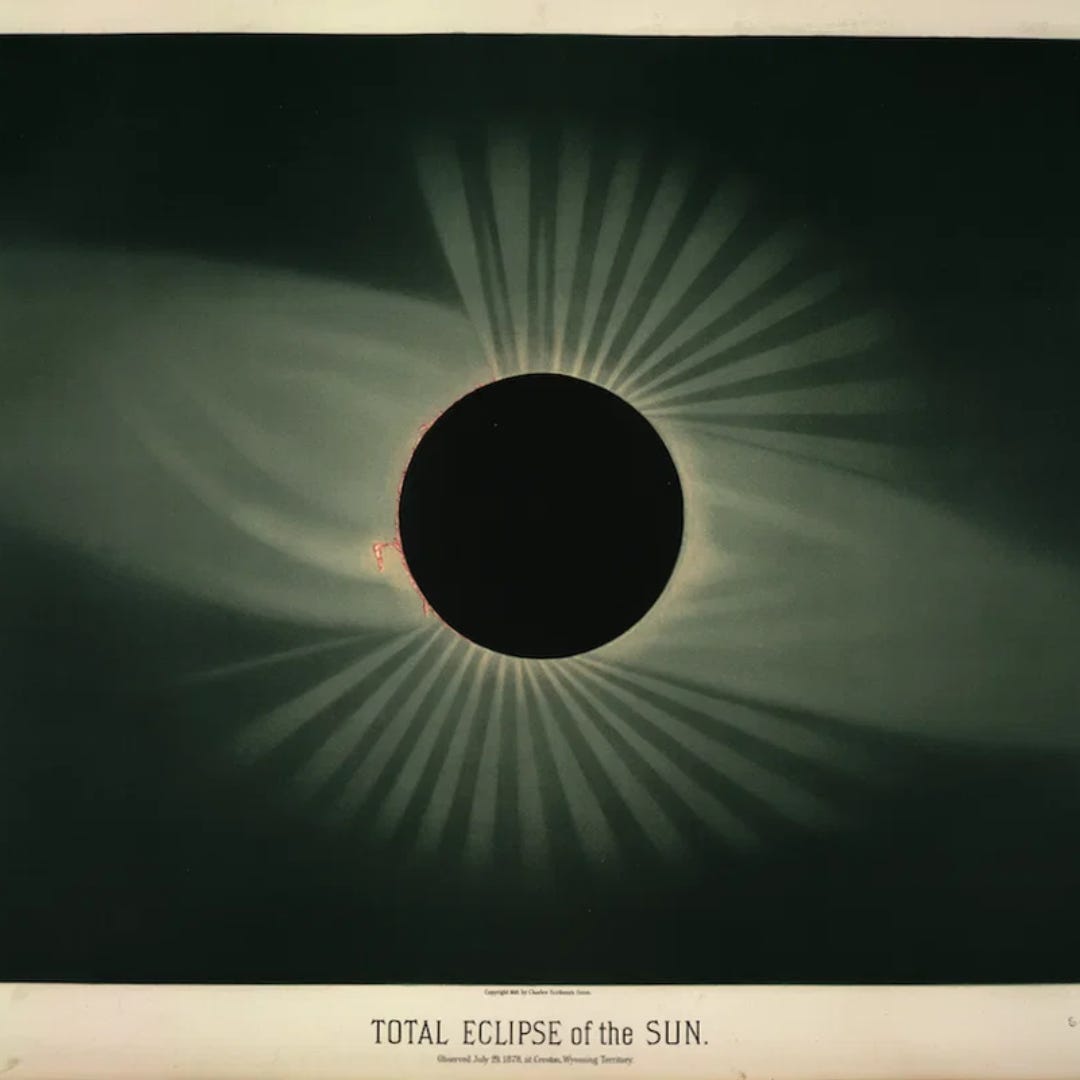
Here is the thing about a planet that orbits the Sun every 19 days: it should cross the Sun’s face again and again, predictably. Astronomers around the world waited for those transits, but they never came.
There was another way to look for this missing planet. The Sun’s glare is so bright that a small object near it is practically invisible unless something blocks the sunlight. Something like a solar eclipse. During a total solar eclipse, the sky goes dark enough that anything hiding in that glare might finally have a chance to show itself.
On July 28th, 1878, a total eclipse crossed through the American West, and two veteran observers went hunting. James Craig Watson, working in Wyoming, reported a reddish object with an apparent magnitude of 4.5. Lewis Swift, working near Denver, reported a reddish object that had an apparent magnitude of 5. So, now we have two scientists who have confirmed what could possibly be a new planet. Unfortunately for Le Verrier, he would never receive this news, for he died the year before.
But there were problems: the two reports didn’t agree, and neither fit a single orbit. Instead, they fit the pattern of a known star in that part of the sky.
In the end, photography closed the case. Between 1901 and 1908, William Wallace Campbell and Charles Dillon Perrine of the Lick Observatory led three eclipse expeditions with cameras that could record objects far fainter than the human eye.
They found nothing.
In 1908, they declared that the intra-Mercurial planet problem, famous for half a century, was finally over.
Einstein Closes the Case
The photographs showed no planet Vulcan, but Mercury’s perihelion still moved an extra 43 arcseconds every century, and nobody had an explanation.
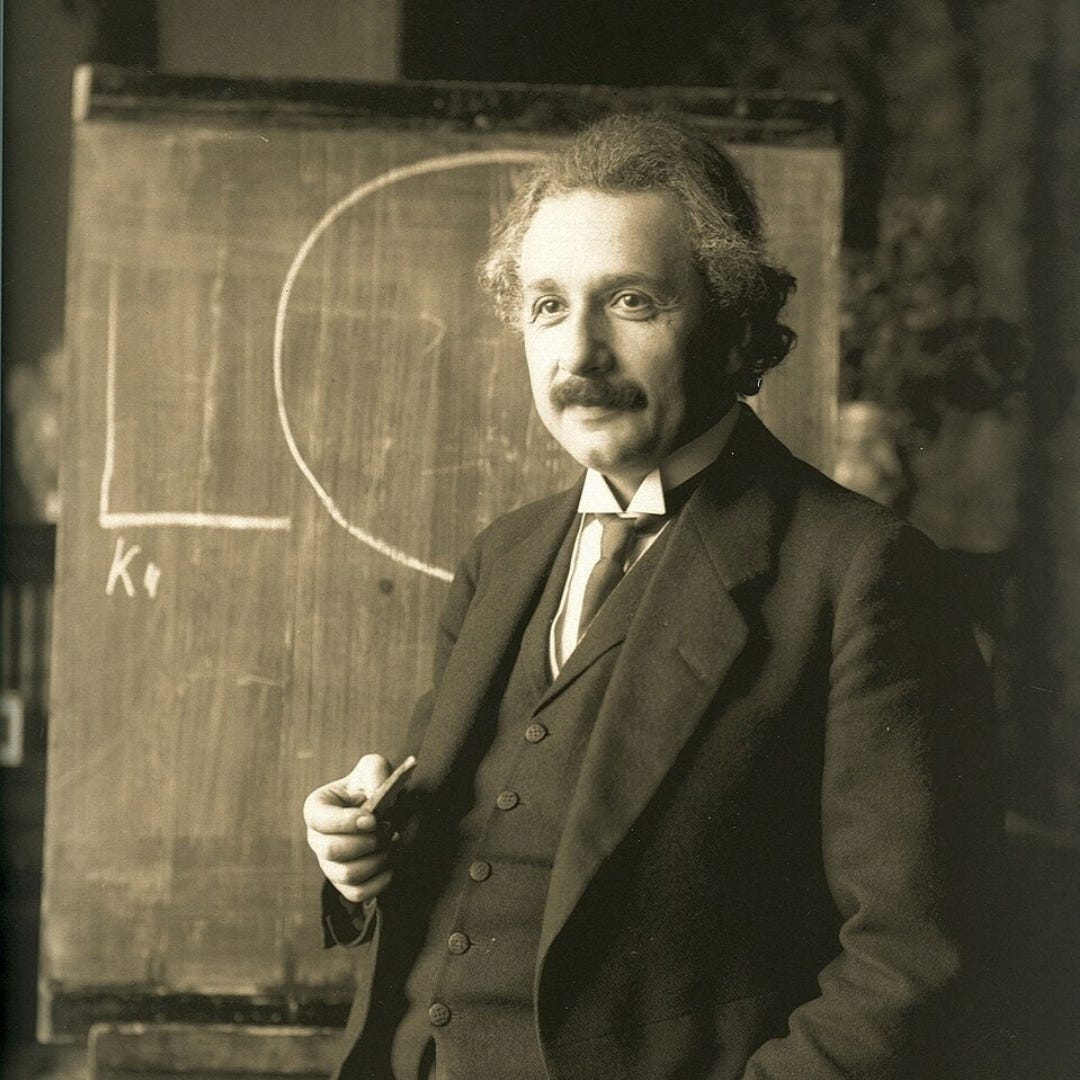
Then, in 1915, Albert Einstein turned his new theory of gravity towards it.
Newton pictured gravity as a force reaching across empty space. Einstein thought that mass bends the fabric of space and time, and planets simply follow those curves. One of the most famous visualizations of this involves imagining a bowling ball sitting on a trampoline with a marble rolling around it. Near the ball, the surface curves steeply, and far away it is nearly flat.
Now replace the bowling ball with the Sun and the marble with Mercury. As the closest planet to the Sun, it rolls through the steepest part of the curve, and as it turns out, this is where Newton’s equations are least accurate. Einstein calculated what his theory predicted for Mercury’s orbit, and the result was an extra 43 arcseconds per century. Eureka!
Einstein’s general theory of relativity was published in 1916, and the need for Vulcan was no longer needed.
Final Thoughts
The story of Vulcan isn’t really a story about a mistake. It is a story about the two choices science has when data and the theory disagree. You can add something to the model, as Le Verrier did with Neptune and then, wrongly, with Vulcan. Or you can change the rules, as Einstein did. Astronomers still weigh those same two options today when they argue over dark matter.
Even though the universe didn’t have a planet to spare, we got to witness one of the most important theoretical advancements in 1915 when Einstein explained Mercury’s perihelion precession through his new general theory of relativity.